

Okay, so you’ve taken an IQ test. But how do you rank on an IQ test scale, compared to others? Learning how your scores stand up is the key to interpreting your results.

The classic IQ test score is a number that reflects your mental age and your intelligence. While 100 is considered average, about 68 percent of the populations falls in the range from 85 to 115.
The Flynn Effect is a phenomenon that suggests people have been gradually growing smarter over the years, which is reflected in an increase in IQ test scores from year to year. Traditionally, to compensate for the trend toward an increase in overall intelligence, IQ tests have been adjusted every couple of decades to make sure that a score of 100 continues to reflect an average achievement.
Recently though the Flynn phenomenon has been coming under question. Studies are showing IQ test scores are now actually in decline from year to year. What’s to blame? Experts suggest genetics, a poor diet and increased reliance on technology may all be factors.
IQ Test Scale: What Factors Matter?
There are some pretty specific factors that can help predict how you might measure up when it comes to IQ. First-born children, those who swear frequently, night owls, messy individuals and folks with a dark sense of humor are known to achieve higher IQ test scores than the average as this article from Men’s Health will attest.
Recent research suggests that smarter people are less likely to pass their driver’s test on the first try. This analysis showed that 59 per cent of people with lower levels of education passed their driver’s exam on their first try, compared to 51 per cent of people who had achieved higher levels of education.
Amazon founder and billionaire Jeff Bezos insists on one surprising trait when he hires the smartest people possible: the willingness to change an opinion. He looks for those who are constantly questioning ideas and approaches, and who are dedicated to finding the best way to accomplish their goals. Evidence of flexibility and adaptability, and the willingness to accept new ideas, are key factors in his hiring process.
But if you are looking for the path to success, a high IQ is no guarantee that life will be easy. Many experts suggest that critical thinking is a more important factor in overall life success and happiness than high scores on IQ tests.
Measuring Up On The IQ Test Scale
When it comes to measuring and interpreting intelligence, there are some general guidelines to keep in mind. This IQ test scale will help you see how your IQ score measures up.
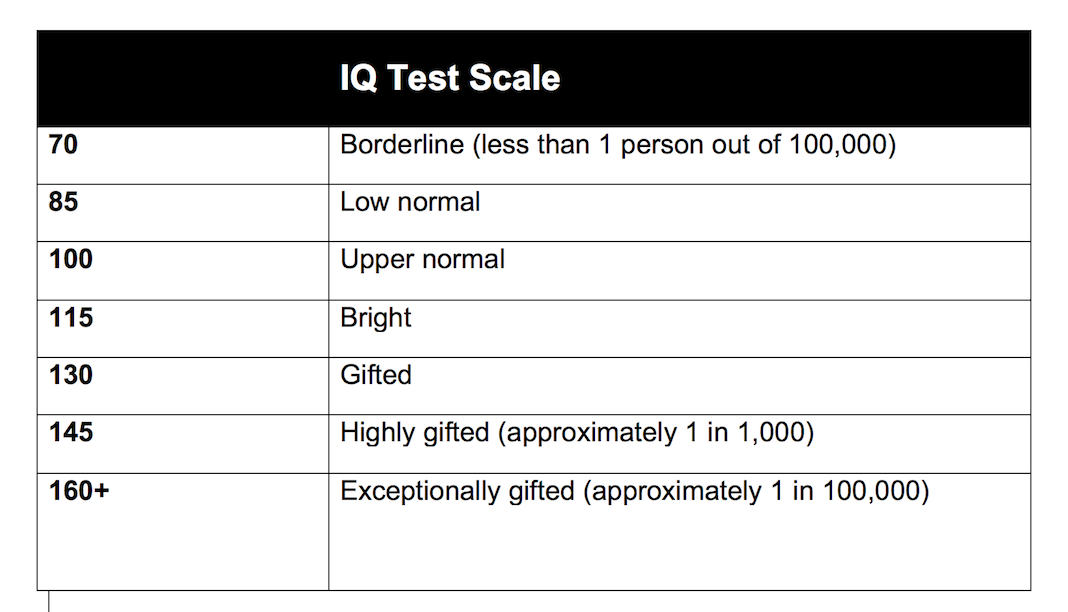 Want to put this into perspective? Experts suggest that about 95 per cent of us will fall into the range of 70 to 130 on the IQ test scale. Those who fall in the remaining 5 per cent? They are extraordinary — for good or ill!
Overall, we’ve come a long way in the way we look at intelligence as a society, and that’s a good thing! Consider how they used to describe scores on the intelligence scale just a few years ago:
25: Idiot
40-54: Imbecile
55-70: Moron
85: Dull normal
Fortunately, we’re much kinder with our terminology now — and much more understanding of the fact that there are many different types of intelligence. It’s not uncommon for someone to have an outstanding score on a traditional IQ test, but to perform very poorly on an emotional IQ test.
Are You Among The Best and the Brightest?
If you scored in the top 2 per cent of the population with your IQ test score — and this achievement varies from test to test — you may be eligible to join Mensa.
Joining this elite group of the brightest-of-the-bright would not only look good on your resume, but it would definitely give you bragging rights, too.
Then again, if your results show room for improvement, you might want to consider heading back to school, and taking some online classes to boost your IQ.
Many experts argue that a high IQ test score isn’t the be-all and end-all when it comes to predicting success and potential achievements. They suggest that elements like executive functioning — the ability to switch between mental tasks, working memory and attention/self-control — may be more important factors than IQ test results.
IQ Test Scale: The Relationship Between Test Scores and Education
Want to see how IQ test scores and education are linked? The following graphic courtesy of Payscale News outlines the average IQ scores by college major. Bottomline? Highest IQs are in Physics and Astronomy (an astronomical 160) and the lowest are in the Social Sciences (an only slightly above average 103).
Simply click on the graphic to enlarge it.

Keeping IQ Test Scores In Perspective
No matter what your score within the range of IQ test scores, be sure to keep your results in perspective! Many factors can affect your IQ score — results can vary from test to test, and they are also affected by how you felt when you took the test.
Your mood, health, alertness, stress level, the amount of sleep you got the night before the test — are also significant factors.
Be sure to keep that in mind when you are considering how you measure up on the intelligence scale.
The title of highest IQ in history goes to writer Marilyn vos Savant. At only 10 years of age, she achieved a score of 228 on an IQ test. This is a feat that has yet to be duplicated — and chances are, it never will be.
IQ Test Scale: Comparing Apples to Apples
It’s also important to remember that not all IQ test scales are created equal. Some tests — the Wonderlic IQ Test among them — use an entirely different scale. So, be sure you are comparing apples to apples when you interpret your IQ test scores.
 With Wonderlic, folks who are literate can expect to score 10 on this IQ test; a score of 20 is normal. These kinds of scores would, however, be cause for alarm on a conventional IQ test.
Above all, remember that the man who discovered the structure of DNA had an IQ of “only” 115. If you look up his scores on the IQ test scale, he was only average, after all.
One of the most powerful men in the world, George H.W. Bush, is widely reported to have an IQ of just 98. If a man with less-than-average IQ can run one of the strongest countries in the world, there’s hope for us all.
Another thing to keep in mind? Recent research is showing that high intelligence isn’t always a guarantee of success. Something to think about!