

The Stanford Binet intelligence test scales are the best place to start if you want to understand the beginning of modern IQ testing.

They were developed in the early 1900s and are the foundation of intelligence testing today.
The French government tasked psychologist Alfred Binet to develop a means that would help identify children suitable for special education programs. So Binet considered elements such as memory and attention, as well as problem solving capabilities.
Binet created tests that focused on various tasks, including drawing, explaining abstract concepts and physical demonstrations such as touching one’s nose. The first test became known as the Binet-Simon Scale.
Stanford Steps In To Revise IQ Test
Psychologist Lewis Terman of Stanford University soon provided revisions that led to what is now known as the Stanford Binet Intelligence Test. The Intelligent Quotient (IQ) is the number that represents a person’s test score. Divide the person’s mental age by their chronological age and then multiply the resulting number by 100 and you get the test score.
Stanford Binet Intelligence Test
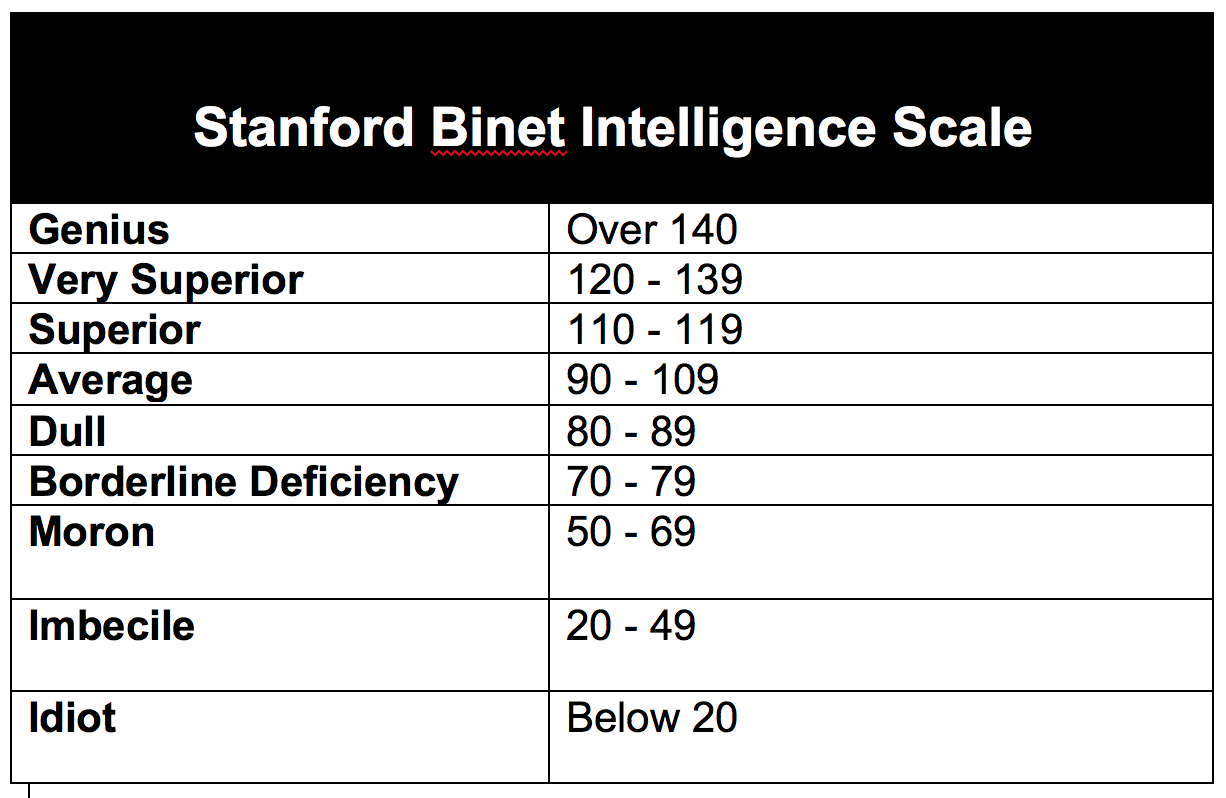
The Stanford Binet Intelligence Scale breaks intelligence down into nine different categories. Be forewarned — these categories reflect the language of the time, and contain terms that many of us today would find offensive.
Stanford Binet Evolves Over The Years
The Stanford Binet intelligence test has undergone various revisions since its inception — and not just to update what can be considered dated language and labels.
While it launched the concept of IQ, it has been tweaked over the years into what is now its fifth version. Today the test considers five key areas, including:
- knowledge
- memory
- spatial/visual reasoning
- fluid reasoning
- quantitative reasoning
About 60 percent of us will score between 85 and 115 on the Stanford Binet Intelligence Scale.
 The U.S. army used the Stanford Binet intelligence test as a basis to screen army recruits in the First World War. IQ tests were also used to screen immigrants. Both uses of IQ tests became controversial, partly because of the recognition that the Stanford-Binet test had limitations, particularly for including different mental abilities.
Today, a score of 132 or more on a Stanford Binet IQ test should qualify you for membership in Mensa. Definitely a goal worth aspiring to!
You can learn all about Mensa IQ tests here.
All About Wechsler
American psychologist David Wechsler created the Wechsler Intelligence Scale (WAIS) in the mid 1950s, and identified tests for specific use with children as well as adults.
Instead of basing scoring on chronological age and mental age, the WAIS was determined by taking into account the person’s score with that of other people in the same group. The modern revision of the Stanford Binet tests takes Wechsler’s scoring methods into account.
 The Intelligent Quotient (IQ) is the number that represents a person’s test score. Divide the person’s mental age by their chronological age and then multiply the resulting number by 100 and you get the test score.
You can learn more about normal IQ scores and genius IQ on this site. Interested in more information on the IQ test scale? There’s plenty more here.
Stanford Binet Intelligence Test: Facts Galore
Still want to learn more about Stanford Binet? There’s plenty of great info here as well.